From a List to a Map: Turning a Bid Archive into a Verifiable Industry Asset
How a hand-compiled five-year award archive became a governed industry map — and why the value of a data asset lies in verifiability, traceability, and governability rather than volume.
This data chain did not start with code. It started with an observation about an industry.
Industry names are generalized here. This is a vertical industry built around offline project delivery, where supplier track records are highly fragmented. General contractors still find subcontractors through personal introductions, and award winners still find suppliers the same way. What a supplier has actually built, and how well, is almost invisible online.
Yet the industry has an undervalued public information source: tendering. Most projects of consequence go through public tender, and tender notices follow a standard disclosure mechanism much like business registration records. The data is scattered across provincial platforms and even company websites, but it is public and solvable.
My team had already hand-compiled about five years of award history for more than two hundred companies. My question was how to turn that list, together with the public record around it, into a trustworthy industry map — a credibility infrastructure that makes a company’s track record legible.
What follows is a series of trade-offs on that road. They point to one judgment: the value of a data asset is not its volume, but whether it is verifiable, traceable, and governable.
A list is not an asset
The easiest option was to merge the archive into the daily tender table. I rejected it.
There were concrete technical hazards: the main table sorts by ingest time, so historical rows would dominate it; the existing three-layer deduplication logic would miss the archive entirely; the anomaly detector would flag thousands of legitimate records; and announcement-stage semantics did not fit the existing categories.
The deeper reason was that the two systems exist for different purposes. Daily tendering is a mature business: colleagues run an automated workflow with human review and keep adding the latest tender and award notices every day. Flooding it with historical data would add risk, not value. The industry map had many features to build, and historical notices were only one small part of it. I did not want this work to become a redesign of a business that already worked.
Historical notices are dead data with a known structure, so I chose the cheapest shape: a separate archive table, with a one-way feed-in whenever daily maintenance matched a company’s award history. Separate storage does not mean separate capability.
I admit this is technical debt. But separating now keeps a clean merge possible later; merging in haste would drag both systems into the mud together.
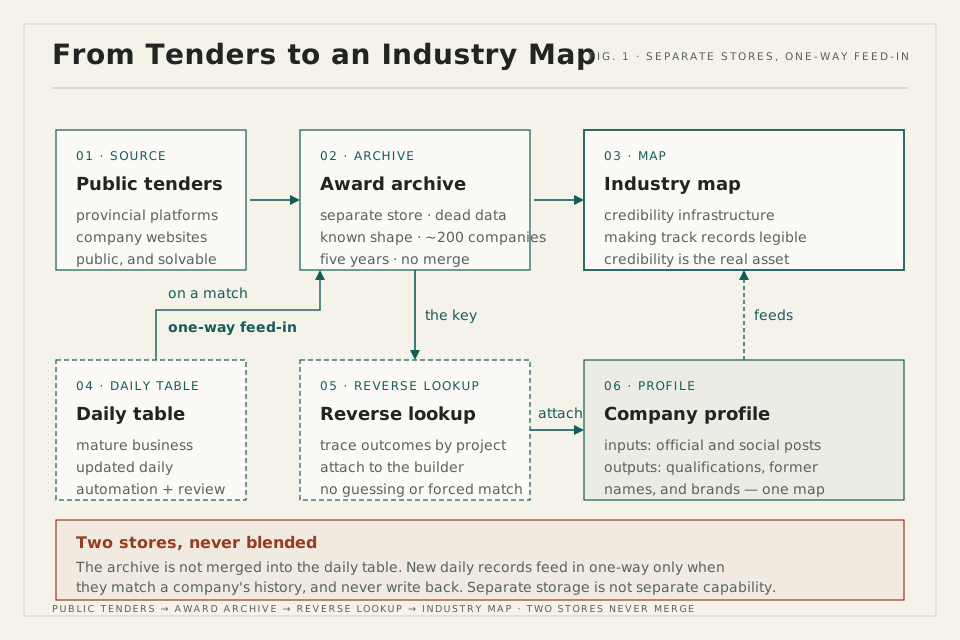
Fig. 1: The historical archive and the daily tender table are two stores that never blend. Feed-in is one-way, not a merge. The asset-making move is reverse lookup: attaching public outcomes back to the companies that built them.
Reverse lookup: attaching public outcomes to builders
Why can a list become an asset? Because award history is not only a set of rows. It is also a key for reverse lookup.
Many project owners — public institutions, for example — publish project outcomes through public channels, but those outcomes were never linked to the companies that actually delivered them. With award history, I can attach those published outcomes to the specific builders.
That produces a chain: use award records to learn which projects a company won; use those project names to trace outcomes and results scattered across social media and official channels; then aggregate qualifications, former names, and brand names into a single profile.
Very few people in this industry were doing that. Whoever builds the resource first has a chance to become the first to establish a credibility platform in a chaotic market. Credibility is the most important thing that platform can hold.
Identity gates: which company owns a record
Turning the list into an asset does not hinge on import. It hinges on one question: which company does this award record belong to?
I did not force matches with fuzzy search. Identity matching is a set of gates. If a record matches a unified social credit code, the code goes first; the field is unique but nullable, so brands and teams without one can still exist. Without a code, only the full registered legal name is trusted, after format validation. When neither is certain, the record goes to a human merge exit instead of being guessed onto the closest-looking company.
Accuracy is a line that cannot be crossed. I graded sources by confidence: automation pulls in the highest-confidence material first, then human review and multi-channel reconciliation fill the picture. I would rather leave more than a thousand rows in a review pool than force them onto the wrong company for coverage — if a hundred of a thousand records are wrong, readers will doubt the value of the rest. Showing less is always cheaper than showing wrong.
The same gates were later reused in two places: importing the historical archive, and feeding in each day’s new notices. One semantics, enforced on both sides.
The classic trap is a joint bid. One notice can involve several companies, and early feed-in swallowed the second one. The fix was to post and attach both: each company sees the record on its own page. That recovered 89 rows that had been silently absorbed.
Intermediate states also have to reconcile. One independent review replay ended with all records composed of a master record and member relations, with zero orphans in the relation table. Some groups ended without a master record. They look like dirty data but are the correct emergence of the deduplication and membership mechanics. Anything that “looks wrong but is right” must be explainable, or the next operator will delete it as a bug.
Deduplication, backfill, adoption: no loss, no duplication, traceable
Import is only the beginning. The real work sits in deduplication, backfill, and adoption, and all three pursue the same sentence: no loss, no duplication, traceable.
One deployment window in September 2026 was relatively complete: the archive was imported, adjudicated, and adopted; multiple-representation issues were cleared; hundreds of rows were backfilled; and the run ended in a reconcilable state with less than thirty seconds of downtime. I will not pile up row counts here. Reuse of the same historical archive on the tender side is documented separately, and this article does not count its scale again; besides, every number needs a date and a definition, and mixing them is how incidents happen.
What I care about more are the parts that were not finished in one pass. More than a thousand rows remained in the name-attribution review pool for operations to work through. Ambiguities where one project had several notices were stopped and handed to a person rather than letting a script pick one. Those gaps were logged as open debts, not hidden inside a success message.
Scoring: turning thickness into a signal users can feel
In the database, data is fields. In front of a user, it has to become judgment.
We built a completeness score led by “thickness”: cases, images, service footprint, qualifications, and identity marks each have tiers, with weights set against real profiles rather than forcing every company into the same fields. Ranking became score-led with near-distance insertion: the nearby view is a separate axis, and companies without coordinates sink rather than burying the ones close by.
Badges only reward. An award-count badge counts only the rows actually visible on the detail page; we do not inflate it. The “focus” badge passes a double gate of whitelist and threshold, and ships with an empty list — better to stay dark than to light up wrongly.
Awards, not verdicts. This is not only a matter of data discipline; it is business judgment appropriate to the platform’s stage. The platform is still growing and needs the industry to build with it. Award winners subcontract to suppliers, and I want the people who actually did the work to come in and claim what they did, what result it produced, and what role they played. Pinning negative labels on the industry at this stage would exceed the depth of my understanding and shut contributors out.
I have thought about the further step. If the platform’s credibility is eventually accepted by the industry, the poor work of clients, general contractors, and suppliers should leave a trace — good money should drive out bad, and that needs a fair, trustworthy platform. But writing negatives is not something to do before the platform has been built.
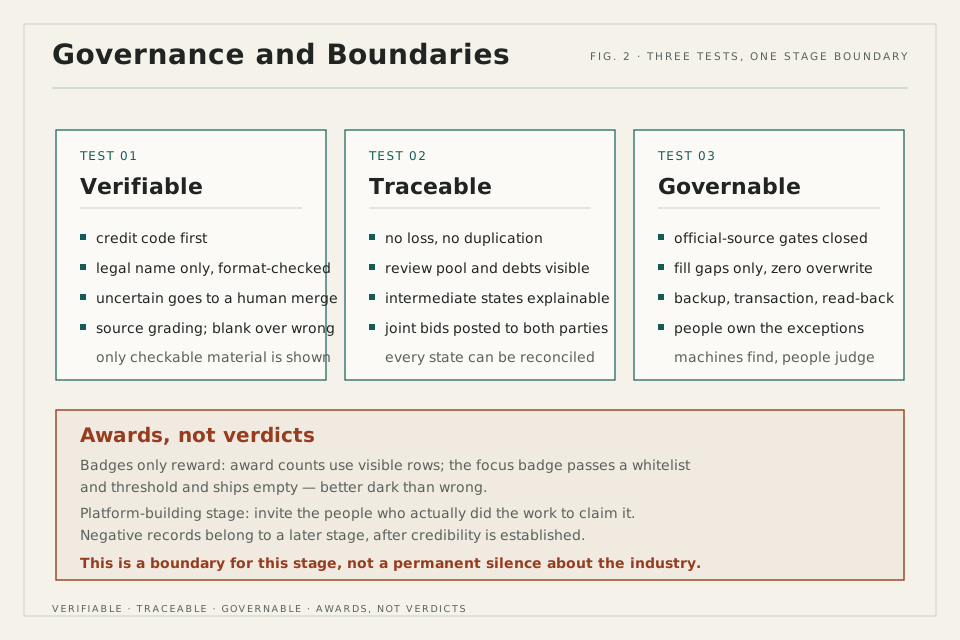
Fig. 2: Three tests decide whether this asset can be trusted. "Awards, not verdicts" marks a boundary for the platform-building stage, not a permanent silence about the industry's problems.
Enrichment: human-only cannot finish, fully automated cannot be trusted
Thickening profiles leaves two extremes, and I rejected both.
Pure manual entry never finishes and does not stay current. Fully automated scraping comes back with content that cannot be trusted. We took the harder middle road: AI does public web research as pre-fill, and people spot-check and give final approval.
In practice, official-source gates default to closed. Even when a company website is captured, it is first judged unusable and only lit up after an individual inspection. This is not perfectionism. Many company websites are dead, and mistaking a dead link or a mismatch for content damages credibility more than having no content at all.
Existing manual assets were protected too. The business-contact information the team had compiled by hand is an existing asset; AI fills gaps only, with zero overwrite and zero deletion.
On visuals, we tried automatically composed colors and text-generated company marks. They were discarded wholesale after review — not simply because they looked bad, but because they made the question of “real” suspect. For companies without a verifiable source image, we leave blank space or fall back to a human rather than laying down a fake logo.
One governed asset, several surfaces
Productization begins only after the data is governed. One cleaned asset feeds three surfaces at once.
In the mini-program, a company detail page becomes a card: an identity section, cases, awards, paginated award history, and a copy-link button. Users can screenshot it, forward it, and trace it to its source. That is data credibility in consumer form.
On the website, every company gets a page that both people and machines can read. We insisted on server-side rendering and structured markup, because many search and AI-reading scenarios have limited support for purely JavaScript-rendered pages; an empty shell rendered only on the client may never be read. That path also means we do not mass-generate hundreds of thousands of template pages. Low-quality doorway pages get demoted, and piling up quantity means nothing.
In search, company names, qualifications, descriptions, and award project names enter one corpus. Award content passes only a gate of “full-name hit plus valid status”; qualifications use dual-mode retrieval. This keeps irrelevant notices out of results.
There is a boundary here that has to be stated plainly. In October 2026, the site’s sitemap grew from 26 to 239 entries, with map pages going from 0 to 213. That is sitemap coverage at a specific date. It is not search-engine indexing, not ranking, and certainly not customer acquisition. Writing it up as traffic growth would be self-deception.
Governance and human adjudication are first-class
The part of this chain I least want to remove is the place of people.
Merging duplicate entries requires backup, a transaction, read-back, and a duplicate check — no bare edits. Residual registered names that should not be exposed, internal notes on off-platform cases, and bare URLs are cleaned through separate cases. When a deployment window turns up several notices for the same project, or a profile entry has to yield, work stops and goes to a person. Scripts are not allowed to guess.
Machines find anomalies, align batches, and finish the repetitive work people do not want to repeat. People own exceptions, accountability, and judgments with no standard answer. This is not a compromise on efficiency; it is why the chain can stay trustworthy over time.
Three judgments I keep
First, the value of a data asset is not volume but verifiability, traceability, and governability. An archive attached to the wrong companies is worth less than a smaller one attached correctly.
Second, human-only cannot finish and fully automated cannot be trusted. The hard path is the middle one: let machines do the pre-fill and discovery they are good at, and let people hold the exceptions and responsibility.
Third, engineering can turn data into a product, but coverage is not acquisition. This system is infrastructure and a process, not a commercial result. Whether anyone actually comes to look, use, and trust it is a different question. Process metrics cannot stand in for outcomes.
Looking back, the deepest gain from this project was not technical. It was a kind of platform thinking: in a chaotic information market, find a public and solvable source, govern it into a trustworthy asset, and protect that trust with restraint. Whether it eventually becomes a platform where good money drives out bad is a question that needs time and contributors to answer together.